

As energy providers navigate growing complexity - data and AI are becoming critical drivers of transformation. At Contact Energy, this is both strategic and practical, with an existing track record of strategic AI projects deployed in production, they are also focussed on with mobilising team members from across their business to help identify new opportunities to use AI.
Corinium’s Vanessa Jalleh spoke to Kate Kolich, Head of Data and Artificial Intelligence at Contact Energy, about how the organisation is bringing its Contact31+ strategy to life through data, advanced analytics, and AI. From hands-on experimentation to real-world solutions, initiatives like Contact Energy’s AI hackathon are helping turn ambition into action.
Contact Energy is leading New Zealand’s renewable energy future, operating 37 generation sites nationwide across geothermal, hydro and thermal assets. Contact supports around 670,000 customer connections across electricity, gas, broadband and mobile.
2. What motivated you to organise an AI hackathon, and what specific outcomes were you hoping to achieve for Contact Energy’s Data and AI function?
We have strong foundations in data and AI at Contact, and a growing set of deployed AI tools that are providing value into our business, and we wanted to provide a space where our broader team across the organisation could engage with building AI capability directly and see what is possible in their own context.
The hackathon was about bringing business and technology teams together to work on real opportunities, not hypothetical use cases. We wanted to prove that AI can deliver practical value quickly when you combine strong business context with the right data, platforms, and AI augmentation.
The outcomes we were aiming for were threefold. First, working solutions that demonstrate real business impact. Second, building capability by giving people hands on experience with AI tools. And third, growing confidence across the organisation that AI can be used responsibly and effectively to accelerate ideas into action. That combination of delivery, learning, and confidence building is what will ultimately scale AI across the business.
3. How did you design and run the hackathon to ensure meaningful, business relevant outcomes?
We were very intentional in how we designed it. It started with the business opportunities, not the technology.
We crowdsourced ideas from across Contact and received over 90, then collaborated with business leaders to narrow those down to around 30 that were feasible within a four-day window and finally prioritised five that aligned to with real business value.
Teams were then formed around those business opportunity statements, with a deliberate mix of technical AI expertise and business expertise. That was important because the quality of the solution comes from combining domain knowledge with data and AI capability.
We asked teams to work with our existing AI platforms where we provisioned safe spaces for them to work. The focus was on building working solutions, not just concepts. We also embedded facilitators, mentors, and subject matter experts into the teams to support teams and challenge their thinking. Judging was based on business impact, feasibility, scalability, and responsible use of AI. Over four days, five teams delivered working solutions to real customer, retail, market, and operational challenges. That was exactly the outcome we were aiming for.
.png?width=722&height=301&name=Date%2c%20venue%20(3).png)
4. How did you crowd source ideas and encourage participation, and what surprised you most?
We opened it up broadly and asked the our organisation a simple question. Where could AI help you simplify the day to day and work smarter? The response was strong. We received over 90 ideas from across the organisation, which in itself was a signal of both curiosity and demand. What really stood out to me was the quality and practicality of the ideas. These were not abstract or experimental for their own sake. They were grounded in real challenges such as plan optimisation, forecasting, knowledge management enablement, and market insights.
Another thing that surprised me was the level of engagement from people who would not usually see themselves as working in AI. The hackathon created a space where all participants felt comfortable contributing, experimenting, and learning by doing alongside AI specialists. This proved that AI adoption at scale comes from making it safely accessible and relevant to everyone, not just a small group of experts.
5. What training or enablement did you provide to participants?
Our approach was centred on learning by doing, supported by the right guardrails. We provided participants with access to our existing approved AI tools and platforms. We also had facilitators, technical mentors, and product SMEs available throughout the event to guide teams and help them move quickly. Importantly, this sat within our broader approach to responsible AI. Participants were working within established frameworks around data usage, governance, and safe application of AI.
The combination of hands-on building, real support, and clear guardrails meant people could experiment confidently and focus on creating working solutions. The feedback reinforced this. People valued the support, the collaboration, and the opportunity to learn in a practical, applied way.
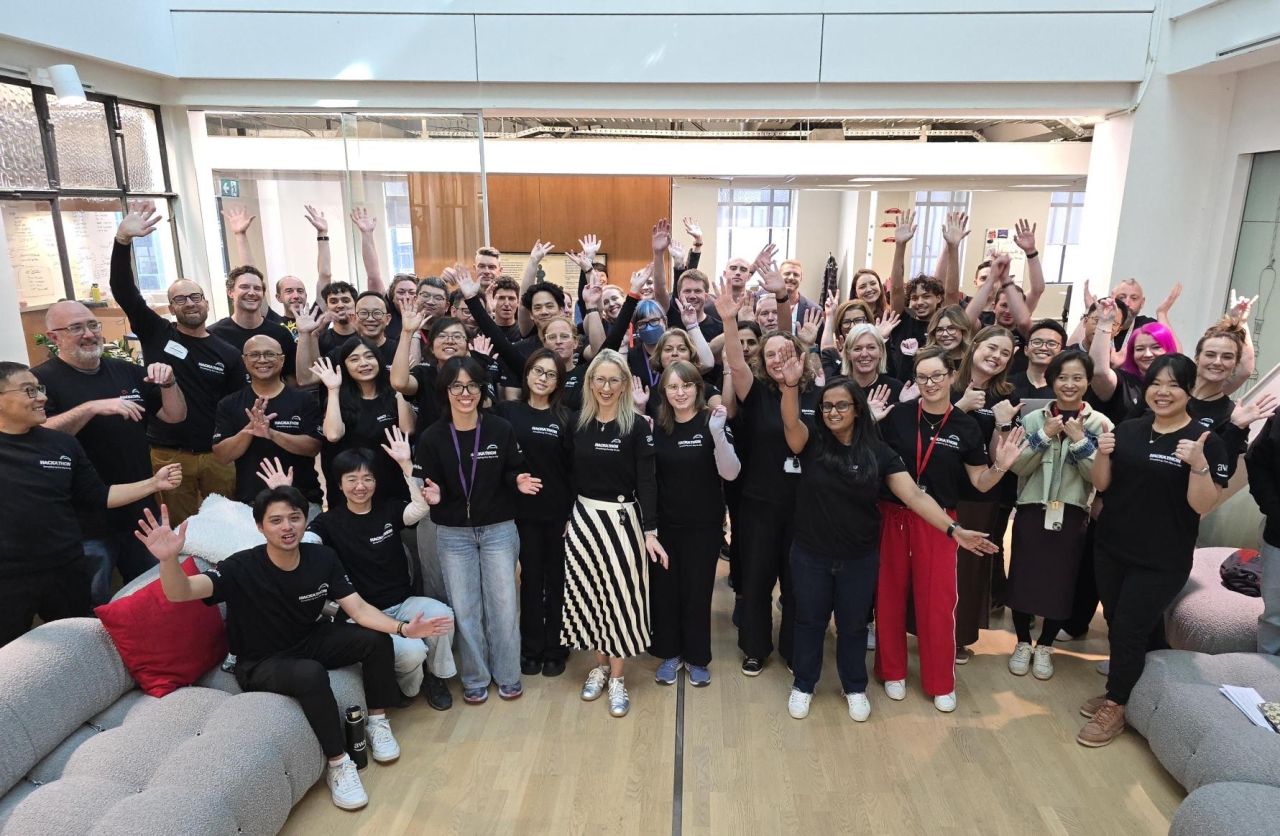 The Contact Energy AI hackathon team
6. What processes do you have in place to take the best ideas into production?
A key part of the AI hackathon design was ensuring this did not end as a one-off event. We treat the outputs as early stage products. Each solution is assessed for business value, feasibility, scalability, and alignment to our data and AI roadmap. From there, we look at what is required to move from prototype to production, including engineering effort, data readiness, and governance considerations. We were very pleased that each solution, demonstrated a scalable and compliant approach. The important takeaway is that the hackathon creates a pipeline of validated ideas that are already grounded in business value and user need.
7. How is the hackathon related to your broader Data and AI strategy?
The hackathon has reinforced and accelerated the direction we are already on.
From a strategy perspective, it validated that bringing business and technology together around real business opportunities is one of the most effective ways to drive AI adoption. It showed that when people have access to the right tools and data, they can move quickly from idea to working solution. From a talent perspective, it highlighted the importance of building multidisciplinary capability. Some of the strongest outcomes came from teams that combined deep domain expertise with emerging AI skills. From an operating model perspective, it strengthened our focus on an AI-augmented way of working. Not just centralised delivery, but enabling teams across the business to use AI themselves, supported by strong foundations and governance. Most importantly, it helped grow a community of people who are confident to engage with AI.
For me, that is the real success of the hackathon, we brought people together to create new business value, we showed that AI is not abstract. It is practical, it is accessible, and it can help us move faster as a business.
Interested to hear more? Join us at CDAIO New Zealand 2026 on 19th October to hear from Kate Kolich and other speakers. Check out the agenda and register to attend here.

.jpg?width=352&name=Location-based%20(1).jpg)