
.jpg)
As defence organisations deploy more autonomous and uncrewed systems, AI is becoming increasingly important at the tactical edge. Moving from isolated pilots to operational capability requires secure, scalable infrastructure that can operate reliably in disconnected environments.
The modern battlefield is changing fast. To keep pace, defence forces are moving AI-powered data processing and decision-making closer to the tactical edge.
That shift is being driven in part by the increasingly widespread use of uncrewed and autonomous platforms across multiple domains. These platforms generate data at a volume and speed that is difficult, if not impossible, for human operators to fully process in real time.
This is where AI can help support faster decision-making, particularly in environments where connectivity to centralised infrastructure may be limited or unavailable.
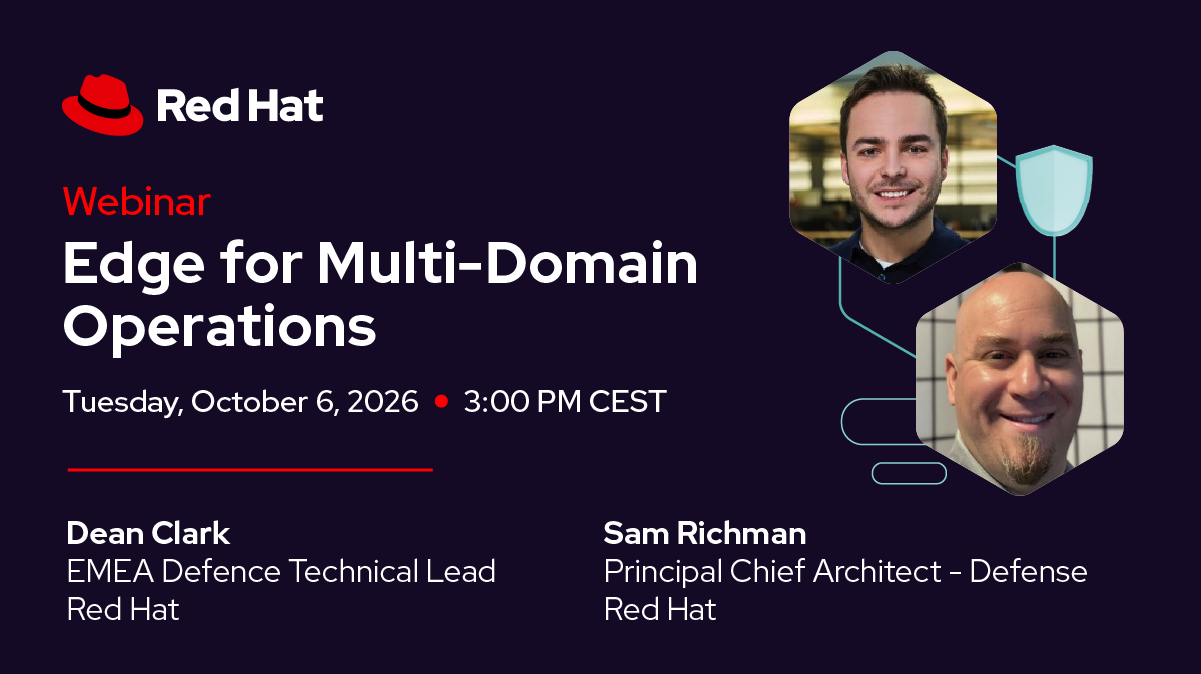
Red Hat’s upcoming Edge for Multi-Domain Operations webinar will explore what it takes to deploy and manage these capabilities securely, consistently, and at scale.
Moving Beyond Isolated AI Pilots
The technology required to run AI at the edge has become significantly more accessible. More capable, relatively inexpensive general-purpose computing, combined with a growing range of large and small AI models, means that many classes of edge devices can now perform increasingly complex tasks.
The real challenge is making these capabilities effective at operational scale.
Dean Clark, EMEA Defence Technical Lead at Red Hat, says the focus must be on managing AI consistently at scale:
“The hard problem is the full-stack mission package: keeping it rapidly deployable, dependable, secure, and consistent at fleet scale, while still being changeable for the next mission,” he says.
That becomes particularly important when systems must continue operating across disconnected or constrained environments.
Keeping Security and Sovereignty at the Centre
As tactical systems become more autonomous, trust becomes even more important.
Organisations need confidence that AI deployed at the edge can be trusted in operational conditions, from the devices themselves to the models and supporting software.
That requires a pragmatic approach to AI. Defence leaders must decide where it genuinely adds value, then choose an appropriate model and deployment approach while maintaining the necessary safeguards and control over sensitive data.
These considerations become even more significant in coalition and multi-domain environments, according to Clark:
“A common, portable platform lets partners share capabilities without giving up control of data, classification, or infrastructure,” he says.
For European defence organisations in particular, interoperability may require multiple sovereign nations to work together while retaining control over sensitive systems and information.
Building Tactical AI That Can Scale
The next challenge for defence leaders is turning promising AI experiments into capabilities that can be deployed and managed at operational scale.
Sam Richman, Principal Chief Architect for Defence at Red Hat, argues that this requires security, scalability, consistency, and speed to be considered together. It also means being disciplined about where AI genuinely adds value and selecting the right approach for each mission.
“Really think about the use case that AI is being considered for and ensure that the right model is being used in the right way for these very serious life-and-death situations,” he says.
In Red Hat’s upcoming webinar, Richman and Clark will explore how defence organisations can build a more consistent foundation for workloads spanning sovereign core infrastructure and the tactical edge.
Register for the Edge for Multi-Domain Operations webinar now
.jpg?width=352&name=Featured%20Images%20(18).jpg)